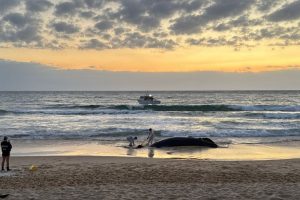
Juvenile whale washes ashore at Alexandra Headland
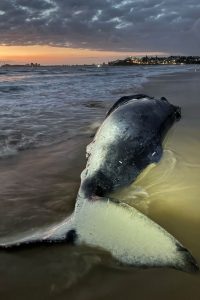
Recovery mission tows carcass offshore
SUNSHINE Coast Council (SCC) crews worked into the night and early morning after a dead humpback whale was reported off the Sunshine Coast on Tuesday, September 22.
Queensland Parks and Wildlife Services alerted SCC at about 4 pm on Tuesday after the whale was spotted floating between Point Cartwright and Mudjimba.
By 5 pm, the whale had drifted towards the northern end of Mooloolaba, with strong tides indicating it was likely to wash ashore at Alexandra Headland.
SCC environment crews moved quickly to establish an exclusion zone on the beach while arrangements were made to remove the carcass, and with first light on Wednesday morning the whale was towed 20 nautical miles offshore.
Crews also collected samples and measurements for research and completed a marine animal strandings report. A GPS tracker was fitted to the whale to monitor its movements and allow crews to respond if the carcass was to drift back towards the coastline.
Sunshine Coast Council Mayor Rosanna Natoli shared images of the incident on her social media account and urged people to keep their distance.
“It is extremely sad to see such a majestic animal like this; however, council crews are asking people to stay a safe distance away… Thanks for your understanding.”
The whale was an intact juvenile female humpback measuring 6.7 metres, and at this stage the cause of death is currently unknown. Council crews have also tested the animal for H5 bird flu.
The incident reinforces the message from Queensland’s SharkSmart program, which advises people to report any incidents of whales that appear injured or are stranded.
Contact the Department of Environment, Tourism, Science and Innovation on 1300 130 372 for whales that strand on beaches, as well as whales entangled in fishing equipment.
People who spot marine animals entangled in Queensland shark control program nets or drumlines, or appear sick or injured can contact the Shark Control Program Hotline on 1800 806 891.
During the annual humpback migration from May to October, more than 50,000 humpback whales are estimated to migrate along the Queensland coastline each year.
How QLD manages whale disposals
Towing out to sea is the preferred method used by the Queensland Government to dispose of whale bodies that have died and have washed up onto the shoreline.
Where a whale washes up onto a beach where towing out is not an option and where the body is high up on the shore and into a dune area, machinery is used to bury the carcass on site.
In areas where towing and the use of machinery is not possible, natural decomposition is the final method used. This option is usually only deployed in isolated areas where the area can be secured and an off-limits boundary enforced in order to allow natural decomposition.